The story
A dark fairy tale in eleven chapters: the saga behind the quests, as the world itself would tell it.
It follows the main story of the game, so it tells what happens. Read it before you play, or after.
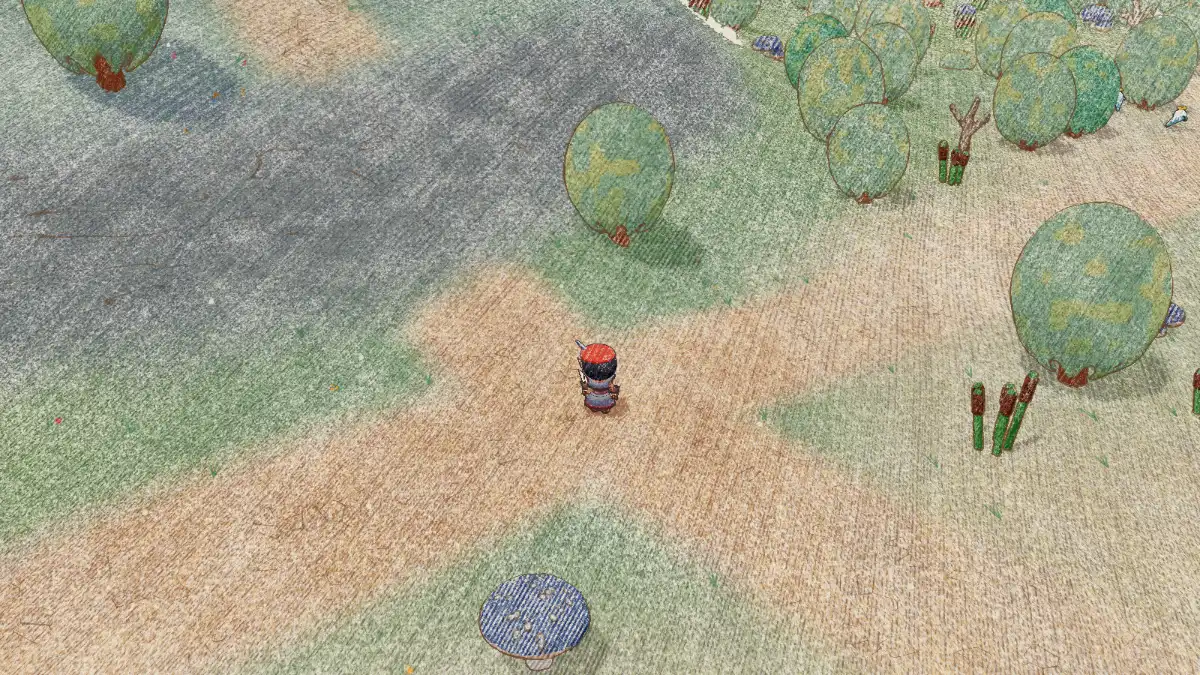
Chapter 1
Before the First Line
Beneath every road you walk lies an older road that was rubbed away, and the paper remembers them both.
Listen close, before the ink dries at your heels, for this world knows what it is. It is no blind accident of mud and stone. It was laid down upon a great sheet of paper, stroke over stroke, and all its laws are the laws of the draughtsman's table. What is drawn in ink stays; ink is stubborn matter, black as deep water, built to endure. Over that ink sits the living world in coloured pencil and soft lead—matter that weathers, shifts, and changes its mind. Where bare white paper shows through, you call it daylight; when night falls, the white closes its eyes and the ink grows bold in the dark. A wound here is a smudge that heals if tended, or spreads if left to fester. And true death—the kind that leaves neither bone nor grave—is erasing. Whoever is scraped from this page vanishes not only from the grass, but from the memory of every soul drawn after them.
Yet paper is a poor keeper of lies. Rub out a line as hard as you please, and still the point leaves a pale groove in the grain—a ghost-line that catches the eye when dawn or dusk slants low across the turf, or wakes when flame is held near. Where the earliest strokes were cut deepest stand the standing stones, keeping Memories of what used to be. And where the sheet was creased into a fold, no scraper could ever reach at all.
A hundred and some winters ago, the maker whom folk call the Hand began his First Draft in warm, ancient media: sanguine chalk red as heart's blood, umber earth, and brown bistre. His very first drawing was a girl, sketched fast and loving before ever he knew hesitation. He gave her a queen's brow and bright eyes, and named her Ysolde—and then he reached her hands, and his gift failed him. Year after year he tried them, and still they stayed helpless scribbles that could close around neither cup, nor brush, nor another's fingers. Ashamed, he drew an entire world around her instead so she might have somewhere to stand: Umberlea and Lowmere, Brinewick and Sanguine March, shadowy Bistrewood, four corner-lands, knights, a court herald named Corvin, an apothecary named Odette, and at last a boy in long boots who could walk straight off the edge of a drawing and make new country underfoot simply by walking. That boy was Aldo, the first Wayfarer, and the first figure the Hand ever finished.
That broke her heart, the old songs say. Ysolde, still unfinished, watched her father finish a boy, a road and a hundred countries: everything except her. Then one midnight the Pumice was taken up from the Hand's table. It is the grey stone scribes use to scrape old writing off vellum, and it scraped. It scraped Aldo first. Then it scraped everything. Already half gone, Aldo ran to the four corners of the page ahead of the stone and folded them tight over the first countries Ysolde had ever been given, and vanished inside the crease. Where the Pumice slipped, it nicked the beasts underneath, and every creature in every land still carries that mustard-yellow mark, and it still hurts. Whose hand held the stone that night, the page will not say. The Inkbound say it was the Hand's.
When the scraping stopped, the Hand was gone as well. Over the wreck somebody drew a second draft in ballpoint and coloured pencil: Pell first, to keep things, then Hearthmere, then the Wayfarers, each one drawn over a worn-thin grave on the only walking pattern ever finished, which was Aldo's. Of Ysolde nobody in Hearthmere speaks. Up in the snow, the charcoal burners say, stands a studio nobody enters, with a wet brush on the ledge of its easel. And in the Atelier above Hearthmere's plaza, gruff old Master Grisaille teaches linework to every new Wayfarer, and nobody can remember when he last drew a line.
Yet the Pumice was never put down. It fell into the Gutter, the dark fold between this page and the next, and there it kept grinding—wearing black Spills up through the thin paper in the shape of the last hand that held it, while the erased world begins to show through again.
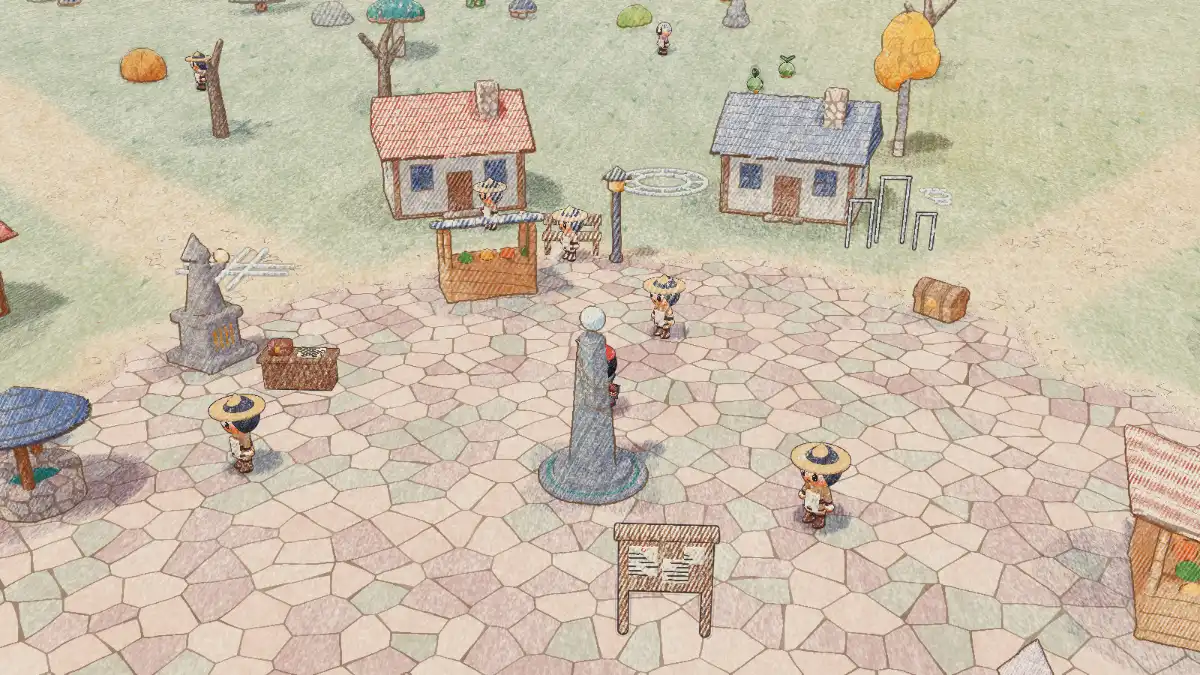
Chapter 2
First Term
A doorway stands alone in a field with no house around it, the grass growing through the frame, and somebody has kept the step swept.
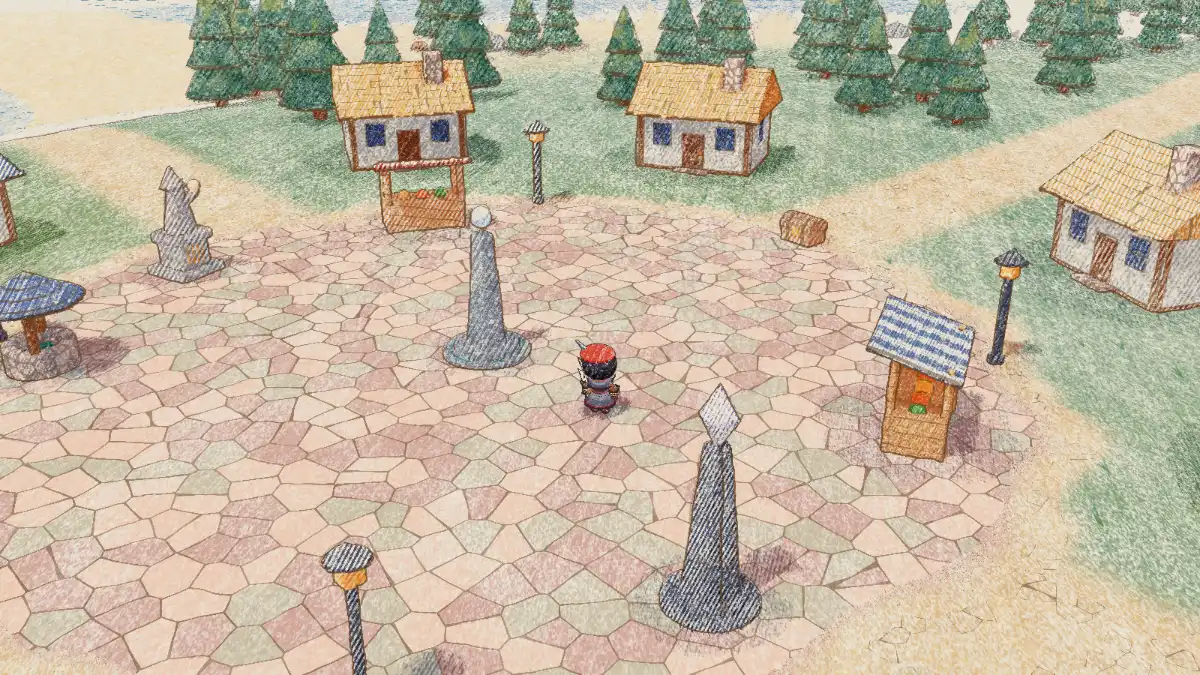
You begin as a whisper of pencil on cream paper. Upon the cobbles of Hearthmere's plaza, a grey outline closes into your shape; colour washes across your shoulders, and the only town every Wayfarer shares wakes around you. Before your boots are dry, a broad man with a broom steps briskly round your heels. Bram keeps Hearthmere's bounty board, and nothing has ever once surprised him. "Another one," he says cheerfully. "Mind the wet bits." You are the wet bits—every newcomer arrives damp from the drawing, warned not to touch their face—and up the stone steps above the plaza rises the Atelier, the old workshop with too many windows where Wayfarers learn linework: the craft of drawing upon the world with intent.
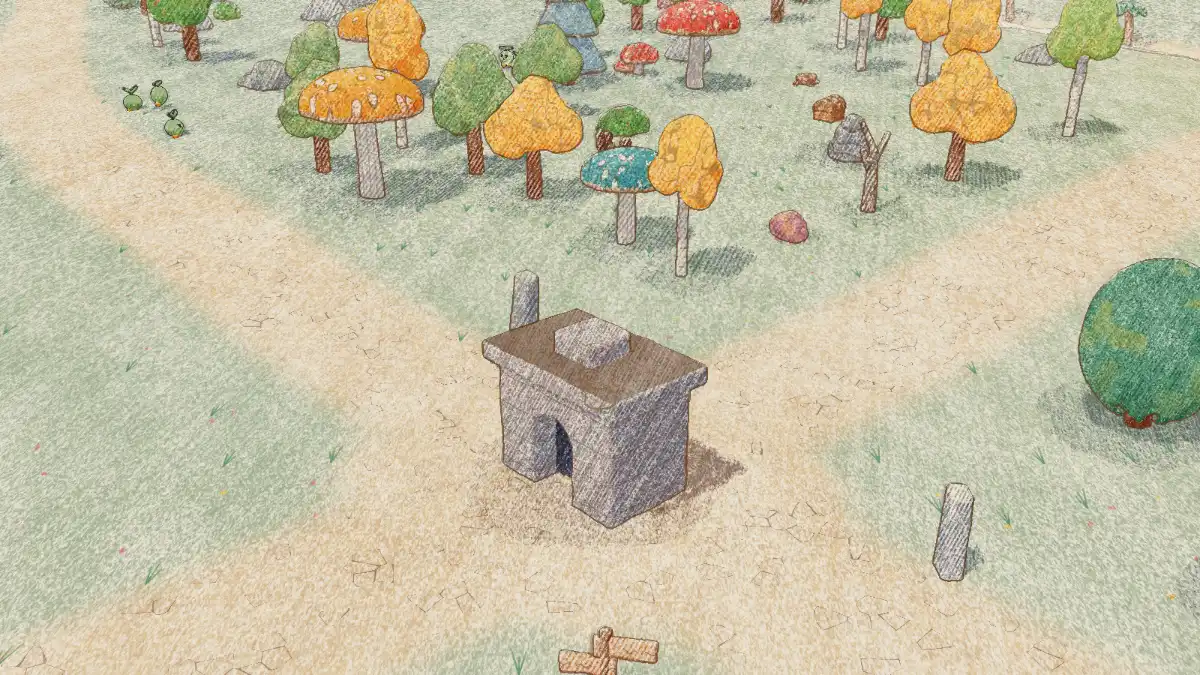
Master Grisaille does not teach his first lesson indoors. Old, gruff, funny, and forever busy with chalk-dust or tea cups so nobody notices he never draws a stroke, he marches the new students out to the Commons and stops beside a doorway standing alone in open grass. No walls flank it, no roof shelters it, yet its threshold stone gleams clean. "Somebody keeps that step swept," Grisaille says. "Nobody in Hearthmere will admit to it." Nothing in a drawing sits there without reason: your first lesson is to notice things, and your second is to put a suffering, badly drawn practice dummy out of its misery with your first purposeful line. "A line is a promise," he warns afterward. "Don't make one you're not going to keep." Ask him to show how he draws, and he waves you off to supper. Later, he promises. Much later.
At the stash counter, dry, patient Pell—who speaks in quiet inventory—opens your drawer and pauses with a mild "Oh." Waiting inside is a pencil sketch of you, just as you stand now, dated a hundred winters ago, bearing a cramped, disguised hand beneath: "Wayfarer, the second. Do not let her see you." Pell claims stray things simply turn up in a very old stash. "Keep it," he murmurs. "Mind the corner. It's older than you are."
First Term soon fills with honest craft. In the Wardens' yard, Master Oswin Hale teaches the oath—"A Warden keeps a door," whichever door you stand before—while by the hearth Master Brannagh Coale teaches Emberwrights that fire is a line that will not sit still and ink a line that will not move, and on the roof Master Tib Farrow tells Striders to walk till they are bored and then walk a bit more. You clear Sproutlings from the hedges, take a bucket at Bram's advice against Shellsnaps in the Millrace and sneezing Puffcaps in the Old Orchard, and let the alchemist Odette salve your smudged cuts with feverfew and mint behind her jar-crowded counter. In the practice yard, proud, lonely Linnet—determined to be the best in your year—challenges you to a Critique, telling you win or lose: "You hold your line like you're apologising for it." Then, quieter, she asks if you got a page in the stash too. Hers says the very same words, though she hides her sketch from sight.
Soon the paper thins beneath town life. Touching a standing stone in the Commons wakes your first Memory: a First-Draft town standing right here in warm red chalk. Gathering herbs nearby, Odette freezes and whispers, "That's Lowmere," before pretending she was merely guessing at names. Overnight, grey ghost-lines surface across Hearthmere's plaza—grooves of an absent fountain, a well, a market cross, and one bare footprint the exact size of your boot. Paper remembers, Grisaille says grimly from his window, swearing nothing lies under Hearthmere save damp cellars.
That night, noise rises from those cellars. Black ink floods the stairs from the first Spill on the page, right inside the Atelier, and humourless Proctor Hask—red pencil behind one ear, hand shaking—musters defence as slumped black Inkbound blots crawl upward, each bearing a mustard-yellow scar. One blot halts directly before you and speaks as if through wet cloth, calling you by a name that is not yours—It's me. It's dark down here—mourning whoever stood in your place before you. Hask's ward line cuts it clean in half into silent ink on the step, leaving one chill question behind: Whose name did it call you?
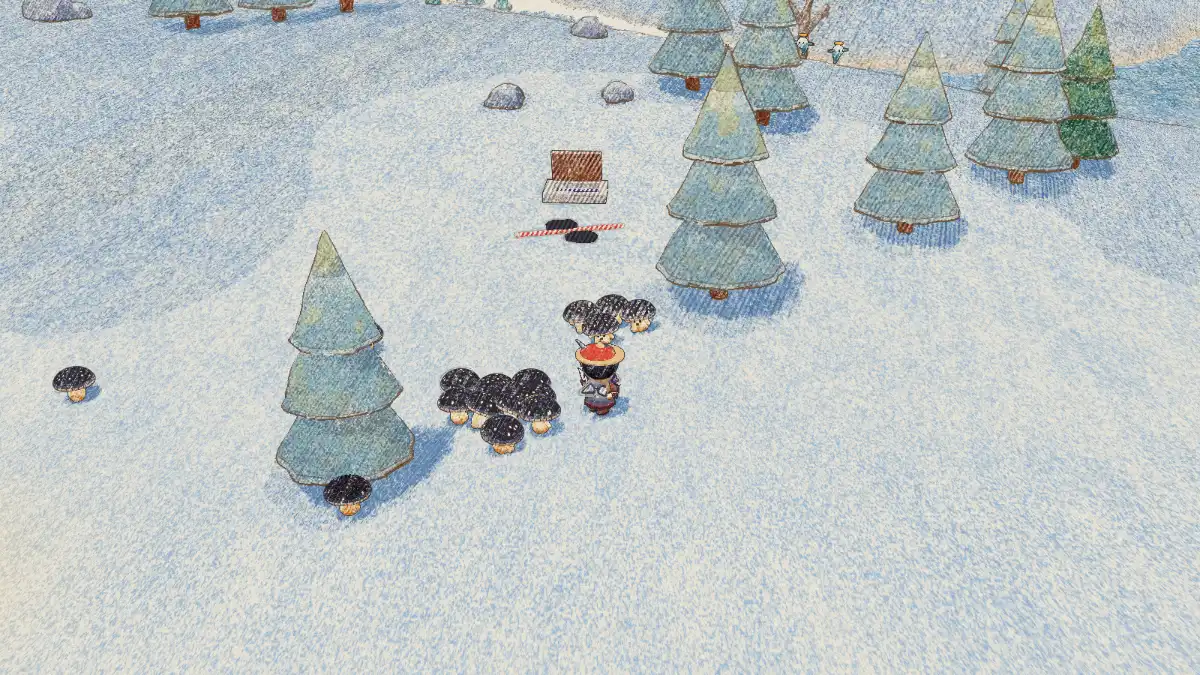
Chapter 3
What the Inkbound Are
Settling them is no cruelty when the ink only wants to lie down and forget how much it hurt to run together.
By morning the Atelier has bolted seals over the cellar doors and blamed the drains. "I've seen plumbing," says Bram, handing out buckets as blots spill into the Old Orchard and the Millrace. "Plumbing doesn't sulk." None of the students buy the story either. Stranger still, whenever a blot settles into quiet ink, it leaves a small relic behind—a button, a ribbon, a scrap of red-chalk writing. Odette asks for every word you find, lining them along her counter in an order only she understands.
Then a white flag comes up the Hearthmere road. Beneath it walks a tall, sad gentleman half faded into grey lead, bowing politely to proctors ready to cut him down. "Herald Corvin, of the Court of the Unfinished, to speak with the Atelier," he announces. "I am harmless. I am very sorry about your cellar." Grisaille lets him in, and as you escort Corvin across the Commons past Puffcaps and Bristlehogs, even the wild blots flinch back from his hem.
Behind the masters' closed door, voices leak through the keyhole. Corvin's court asks only for "the second", for when his queen wakes. Grisaille answers, calm as ice: "There are hundreds of them. You can't have any." She is asleep and cannot open a door, Grisaille says—until Corvin warns that Mother Rasp has people for doors now. Coming out empty-handed through the great hall, Corvin pauses to pat your arm with mournful courtesy. "She will not be looking for you," he tells you softly. "Please remember that later. It will matter to you that she was not looking for you."
Sitting later upon the swept step in the Commons, waiting for an answer that never comes, Corvin tells you plainly what the Inkbound are. They are not monsters born of shadow; they are First-Draft folk scraped away and run together by ink until a dozen neighbours forgot whose edges were whose. Being a blot hurts; being struck down lets the ink lie flat and go quiet. "Settling them is a kindness. Truly," he says. "Please do not feel bad. We would very much like to be settled." Back at Odette's brazier—or under an Emberwright's held flame, the way Master Coale reads hidden lemon-juice scone recipes—the red-chalk scraps warm into a single message: "The Hand scraped us. The queen is waiting. The step is swept." Odette sits down hard, calls the Hand a children's tale, and tells the one plain lie of her life: that she could not say who the queen is.
Before the sorting, the three Studio masters test your hands and your creed. At dusk by the cellar seal, stern Master Aubrey Gall of Studio Sepia—who lost his mother to a Spill and swears "What is inked stays inked"—sets you guarding the school from the dead below. Under the roof in the Tracing Loft, curious Master Tobiah Plumb of Studio Graphite—preaching "Every line can sit on another"—sends you with vellum to trace the swept doorway's groove. Out in the plaza, bold young Master Ione Whiting of Studio Chalk—whose motto is "Wipe it and do better"—hands you a rag to scrub away the ink stain and raise a stout new bench instead.
Then the cellar seal gives way. Grisaille sends you down with Linnet and big, cheerful Dunstan—a Warden student hopeless at fine linework who remembers every hidden jug of cider and knows at once that the red-chalk staircase winding far beneath the cellars was never there before. Past a ghostly wall-mural of a crowned girl with scribbled hands waits the Heart of the Cellar, a room-sized blot of dozens of tangled souls. When your blades settle it at last, overlapping voices breathe your hidden predecessor's name alongside one word nobody recognises: "Aldo."
Back in the plaza, you mend a torn ghost-line before the masters—inking it fast for Sepia's Scriptorium, drawing beside it for Graphite's Tracing Loft, or wiping it anew for Chalk's Slate Yard—while the phantom fountain stays visible in the cobbles forever. Yet leaving Hearthmere by a penned Bristlehog on the south road, Corvin touches the mustard-yellow scar on its flank. "Every beast has one," he says, looking back up at Grisaille's lighted window. "It's where the Pumice slipped. It nicked them, underneath. It still hurts. Ask your master when he last drew a line."
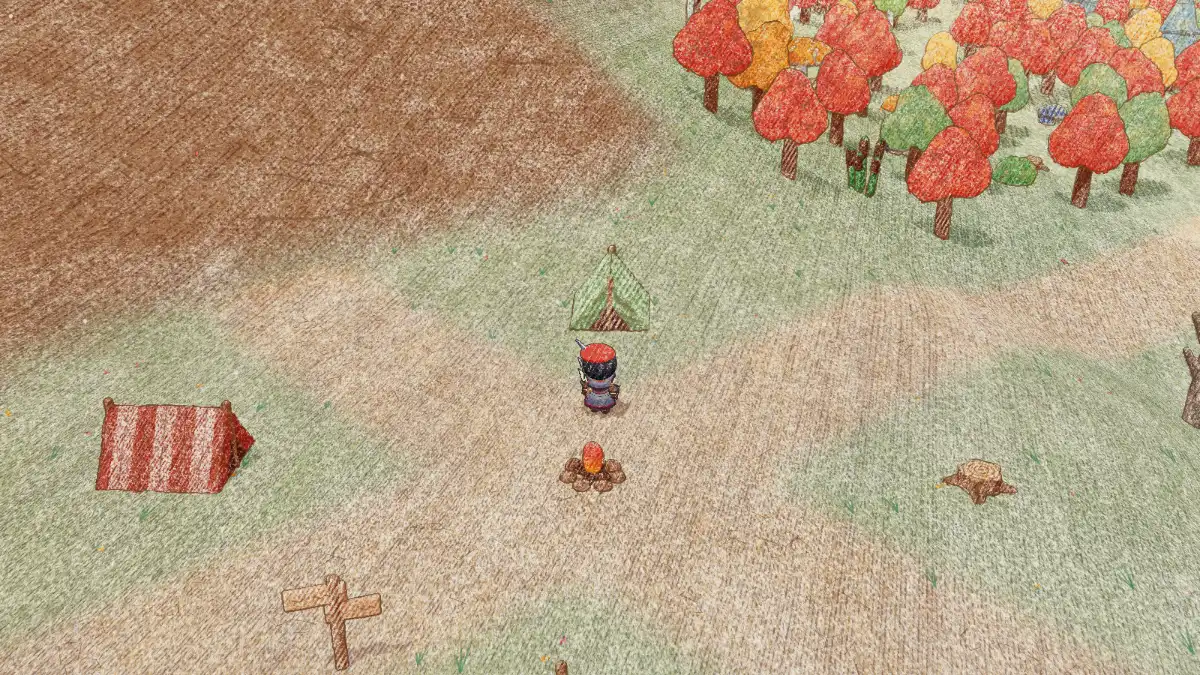
Chapter 4
Field Term
Where the last inked furrow ends, the village stops dead, watching your boots sketch new hills out of bare white air.
Every first-year spends a season out in the open, walking the world wider. In a classroom lined with books and not a single drawing, Master Grisaille pairs you with Linnet precisely because neither of you wished it, handing over a blank Field Term map. "Bring back three things you've never seen," he orders. "Not the same three as her." Ask him Corvin's question—when he last drew a line—and Grisaille never lifts his head, saying dryly that announcing people does not make a herald right about them. At the north gate Linnet waits cross-armed, insisting she was early rather than waiting for you.
North into Larkmeadow, across windy grass and tugging kites on the Lea, stands Fallowgate. Past its barley runs an invisible border: the last inked stroke of their country. Reeve Wendle and his neighbours cannot step beyond it; second-draft feet simply refuse the bare paper. Yours do not. While the whole village crowds the wall in hush, you walk past the barley—and like frost spreading across a cold pane, turf and track sketch themselves in beneath your soles. Old Hollis laughs wildly from the wall to see his grandfather's stories proved true.
Older echoes stir along that road. In a ring of standing stones guarded by Craglings on the Lea, a Memory shows First-Draft Larkmeadow beneath a queen's banner—and inside that vanished day, a small child turns, looks straight through a hundred winters, and waves at you alone. Children in Memories cannot see the living; shaken Linnet marks it down as thing one. East on windy Kitefield, Old Wenna stands with a crook and no flock beside an ancient barrow where the first open Spill gapes black as the inside of a boot, having swallowed her sheep down among "the first lot". When you close its pour with fellow Wayfarers or alone, Wenna steps onto the warm stain as though someone had just risen from sitting there.
Turning clockwise into Petalwood, where two pages squash together and bright bellflowers grow flat as dried leaves, young Hen of Marrowby—who keeps a pressed midsummer bloom in her shoe against the pox—leads you to the edge of the Pressing. There, matching a standing stone's Memory upon the great wooden flower-presses opens the deep sheaves, and all warmth drains from the wood.
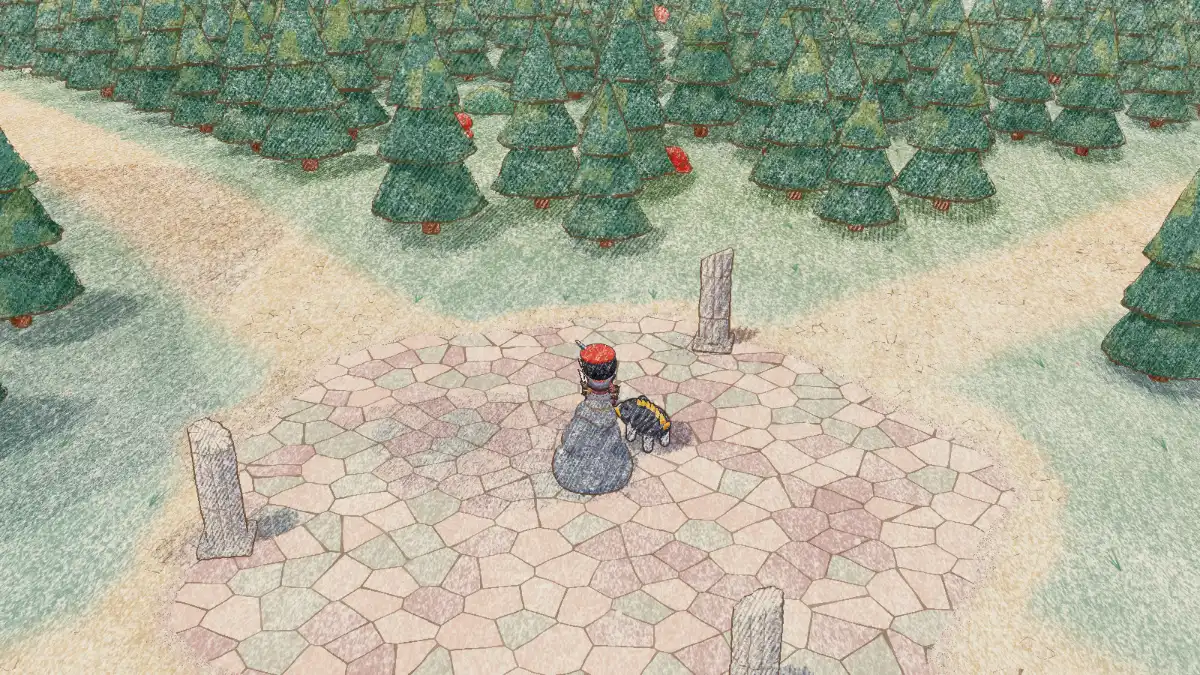
Long, thin grey figures stand waiting with flat hands like palette knives: Mother Rasp's Scrapers, hunting for a sleeping court. They have nervous Strider student Pip Marrow pinned to a trunk. You rush in; beside you, fearless Linnet freezes stone-still. Alone you fend off those whispering blades until one Scraper hooks a flat finger under Pip's outline and lifts it like the corner of a page. Underneath blinks a bewildered First-Draft man in brown umber. "Not him," rasps the Scraper, like iron on slate, letting the flap drop back—leaving Pip alive, clutching a grey patch on his shoulder that will never colour back in.
By the Marrowby inn fire that night over untouched cider, Linnet confesses she froze because when Pip's outline lifted, for one heartbeat she thought she saw herself underneath. Calling you by name for the first time, the pride of your year begs you never to tell a soul she was frightened. With game little Pip beside you, you clear the Flower Press of Bindweed—a vast blot woven of pressed blooms and the vanished folk who pressed them—winning a Pressed Rose that never browns.
Back at the Atelier, the Field Term maps hang pinned along Grisaille's wall, and Grisaille stands before yours very still. Beside the roads you walked, someone has drawn a road you never trod—cutting straight west from Hearthmere across Saltreach into the sea, in old red chalk, marked in the disguised hand from your stash page: "Aldo's road. Low tide only."
Chapter 5
The Drowned Lesson
Twice a day the salt water pulls back its sheet, and a town drawn in bleeding red chalk rises dripping from the sea.
Word of a drowned First-Draft town surfacing only at lowest water sets the three Studios racing for the Laurel, that seasonal wreath of real, undrawn leaves above the Atelier's door. Each master briefs their house differently: Gall orders Sepia to rub the walls, seal them, and bring back no opinions; Plumb packs Graphite satchels with blank sheets to copy every scratch; Whiting tells Chalk simply to get there first.
South and west through Reedmarsh, past the Shallows' eel weirs to the stilt-town of Sallow Ferry, Old Saul the ferryman refuses to pole west at low water, reciting his grandmother's rhyme instead: "Aldo walked the low road, and never came back up; leave the door, leave the cup, Aldo's never coming up." Out in the deep reeds drifts Grandmother Blot, a vast, slow shape humming lullabies in a hundred grandmothers' voices—and if you wait quietly for her song to reach its closing note before settling her, one gentle voice thanks you before the ink goes still.
Beyond lie the Withy Fens, the first contested territory where sheltered training ends and Studio colours mean drawn steel. Proctor Hask meets the students at the marsh edge, red pencil ready, laying down the law: rivals may clash in Studio colours, or walk dark-outlined in Uncapped ink, yet killing an unwilling traveller earns red-pencilled corrections upon your name, barring you from town services until road-side basins at the Wash or long hours copying the Hand's old sheets for Clerk Mottram in the Copy Room fade the crimson away. "Disagreements are allowed," Hask says. "Murder isn't."
Across Saltreach's windy Strand, twice each day the sea retreats to bare Aldo's ghost-road: a boy's footprints marching straight under the waves—with a smaller girl's wobbly prints beside them, scribbled hands held wide for balance near a buried ribbon, for Strider eyes to find. Past Gullhaven—where the Exhibition opens its market boards and the smith Tamsin talks to iron like a nervous horse, teaching Re-inking with Soot and Oak Gall, pigment Inlays of Vermilion or Ultramarine cut with a Burin Point, and Odette's Fixative to stop a slipped line sulking—dead low tide uncovers the Tidestones, and Brinewick rises dripping, its red chalk bleached pink with salt.
Its four walls tell the First Draft's story in pictures: a flower-crowned queen with two scribbles for hands; a boy in long boots walking off every frame; a court with Corvin, knights, Sir Brannoc, and an herb-woman wearing Odette's face; and last, a great hand gripping a stone, scraping, above a scratched line: "The Hand scraped us." While Studios battle to hold the Tidestones in the Hanging, Linnet kneels by a tide-pool in the slanting light. Under her reflection laughs a girl in an umber apron, and heat held near Linnet's arm wakes hidden ink on her skin: Isel. No longer frightened, Linnet burns with shame. "That's a goose girl's name," she whispers, begging your silence again. "I'm standing on a goose girl."
Down in flooded Brinewick Deep waits Sir Brannoc of Brinewick in barnacled armour, still guarding a doorway no longer there. Unwilling to fight yet bound by oath, he blocks until his shield breaks in the rising sea, then swings two-handed, fast and sorry. Falling to one knee in the water, he asks if the queen is safe—and to a Warden, speaks the uncut ancient oath before yielding his rusted door-ward: "I keep the door. Hers."
You come home to Hearthmere and find Odette sitting on her shop step, hands in her lap, her outline fading at the edges like a drawing left in the sun. "I'm Erased, love," she says quietly. "I was Ysolde's apothecary. I was there." Somebody kind drew her back so she could watch over the girl, and she will not break her promise to name him—yet every open Spill pulls a little more of her down. "Close them, would you? I'd like to see how this ends."
Chapter 6
The Winter Studio
Fresh snow is blank paper too, rubbing out every traveller's track by morning—save the roads drawn without a tremor of doubt.
Wearing gloves now to hide her thinning hands, Odette gives you an old recipe for Fixative, the spray that holds a drawing fast to its paper. Its herbs grow only in Deepfir's deep snow: Rimecress, Frostwort, and Hob's Tears. Before you take the north road, she adds a quiet warning: folk speak of a studio in the snow up there, and you must not go inside it on your own.
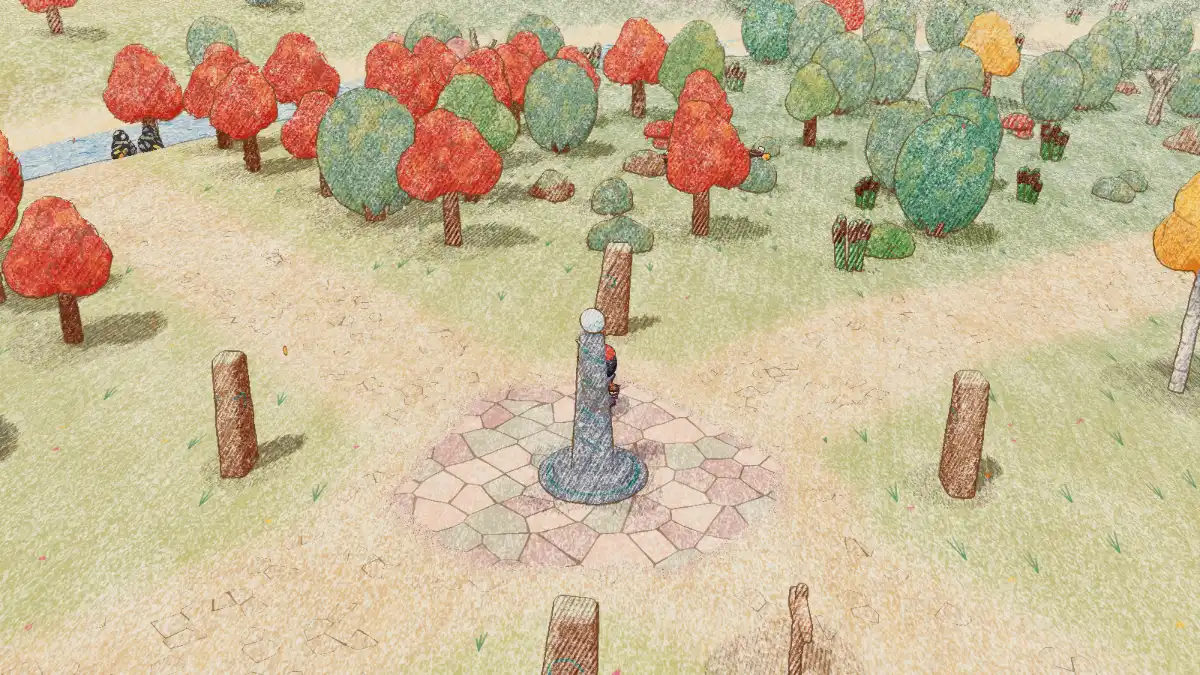
At Hob's Halt in Firstsnow, Warden Gudrun knocks snow off a post and explains Deepfir's trouble. "Snow's paper too, see. It's blank." Every snowfall rubs out footprints and fades the Long Walk overnight, so Hob's Halt pays Wayfarers to keep the markers inked. Yet cutting north-east run a few roads that never fade—perfect, unhesitating lines walked by nobody Gudrun knows, shunned because they lead straight to the studio.
Following them brings you into the Hush, an old fir wood without birdsong. Something stalks you through the trees, freezing like a posed statue whenever you look back—taking your stance, then Linnet's, then a child's—leaving only a jointed wooden finger in the drift. Beyond stand the abandoned glasshouses of Coldframe, teeming with crawling red-chalk hand-studies: a hundred attempts at a girl's left hand, every one wrong, bearing a small, impatient signature on torn sheets—"The thumb again. Why is it always the thumb. — G."—which Master Plumb reads by Ink Post in breathless wonder.
Clockwise through frost-white Hoarwood, past Rimewick's charcoal burners in Rimeholt and into the Rooting, you face the Old Hog, a barn-sized Bristlehog patriarch bearing a mustard mark wide as a door. By night in Lantern Hollow, grey-shouldered Pip Marrow guides you past Glimmerwisps and asks to be walked to the Margin one day so he can say he saw the edge. South at the Thaw, however, Linnet's camp is cold. Sleepless since Brinewick, she has gone back north through the snow alone, leaving a note: "Gone to find out. Don't follow. You'll follow. Bring a coat."
Deep in the drifts stands the Winter Studio: a cold stove, an empty chair, unsent letters stacked on the mantel ("Y. — Today I tried the left hand again. — G."—letters whose fuller grief warms into legibility when an Emberwright brings a live coal from Hearthmere's hearth to relight that cold stove), and upon the easel, Ysolde asleep, beautifully drawn in sanguine save for her scribbled hands, a still-wet brush resting on the ledge. Linnet stands before the easel crying without knowing why, touching Isel's name on her arm—just as the Lay Figure rises from the chair to guard the sleeper, mirroring your pose, Linnet's, and whatever you fear most, taunting you with your under-figure's name before splintering apart.
You turn back from the broken Lay Figure, and the easel is empty. The brush is gone. Bare footprints lead out into the snow, each one a little more finished than the last. "I think we woke her," whispers Linnet. "I think we woke her by being here." And from the doorway, Herald Corvin answers very softly: "Yes. You look like him. All of you look like him."
Chapter 7
Overdrawn
Two families hold keys that turn the very same lock, one drawn in living pencil and one returned in bleeding red chalk.
Awake and clutching the wet brush in hands that cannot hold it, Ysolde begins drawing the First Draft back over the southern world, country by country. Tollbridge in Amberwood wakes drawn twice: living townsfolk in pencil standing beside returned predecessors in sanguine, Agna's polite great-great-grandfather collecting dead coins at her bridge while asking after his vanished wife. They are not monsters; they are bewildered families wanting their houses back. In a home crowded with two of every chair, Reeve Mallory puts the choice of Two Keys before you, for two families of the Hobs hold keys that fit the lock: house the returned elsewhere at Studio Sepia's cost, draw a second door as Graphite counsels so both share one roof, or bring planks to wipe and redraw a bigger house in Chalk's fashion.
Across the golden resin trees of the Amber—where First-Draft folk, beasts, and even a Scraper hang caught mid-step—and out over rotting Leafmould, Ysolde's Scrapers hunt Wayfarers openly in sweeping packs. Here the mystery becomes a moral wound, and the Studios split along their own temptations. Sepia holds the Cinder Wall until an officer orders behind-the-wall farms burned so the returned have nowhere to shelter, a cruelty Master Gall backs you in refusing. Graphite parleys with Corvin under a white flag in the Amber while a living village downhill goes thirsty for a well left to ghosts. And in the Overdraw, Chalk wipes a field clean of sanguine and pencil both—leaving Whiting pale when a child in pencil vanishes beside the red. "That wasn't the plan," she whispers.
Retreating into ash-grey Cinderfell—past the Clinker's slag hills and Gall the Unwashed, through Kilnside where First-Draft kilns still hum to Emberwright ears—sorrow strikes upon the Ashfall road. A Scraper Sweep hits terrified first-years at the bridge, and big, cheerful Dunstan plants his shield across the boards so they escape. "Go on!" he shouts. "I'm big. I'm in the way. It's the one thing I'm good at." You arrive as the Scrapers lift his outline, rasp "Not him," and this time do not let it fall: like iron on slate, they scrape him gone, leaving only his dented shield. Next morning, his bunk in the Warden dormitory is blank paper. His name is missing from the Register; Master Hale, Bram, and the children he saved have forgotten him—until a Warden makes Hale read your notes on that bridge at dawn and watches him weep without knowing why. Only you and Odette remember; taking your hand, she whispers, "Write it down. Write everything down."
At night, the Atelier itself turns into Ysolde's sanguine palace, its corridors hung with sketches of hundreds of Wayfarers—yours, Dunstan's, and behind yours, your under-figure's face—every one scrawled with Ysolde's note: "Not him." Whispering behind the throne-room screen, Linnet steps out before Ysolde as laughing Isel rises beside her—"Can I have a turn? Just a little one?" Refusing to be scraped, Linnet goes willingly with Ysolde's court so Isel can walk beside her rather than underneath. In the Gallery of Not Him, captain Mother Rasp lifts her own Scraper skin to fight as the furious Lowmere washerwoman she once was, searching under every face for her lost daughter; falling, she tells her whole story in four plain sentences and asks you not to make it a story.
Come morning, Pell is gone from Hearthmere. A note on the stash counter reads "Back soon. Take what's yours," yet his oldest drawer—never seen open—stands ajar. Inside lie a hundred winters of notes on every Wayfarer who ever lived, yours and Dunstan's among them, pinned to copies of your stash pages—and correcting Pell's notes in small, impatient margins is Master Grisaille's unmistakable ordinary handwriting.
Chapter 8
The Margin
At the top of the stair where the paper ends in white, an old man dangles his boots over nothing and tells the truth at last.
Grisaille's classroom is locked, his chair still warm. While Gall, Plumb, and Whiting argue in the Critique Hall, Herald Corvin waits at the Commons gate without his white flag—off duty at last, offering to guide you east down the Queen's Road into Umberlea, alive again in warm brown ink. Here you are the ghost: First-Draft carters squint through your thin edges as one of "the faint ones". In Umber Cross, young Nell Ambergate lends you her brown wool coat lest thin edges make you cold, while Marl airs the faint room at the Gander and Cross.
Hanging Corvin's court rolls in procession order reveals one parchment written on the morning of the ruin and never unrolled: "Aldo, the Wayfarer, who is everywhere and will not stand still to be announced." Past easel-marked Old Court, you defend Isel's mother Goody Gosling with pitchforks against Scrapers in the Orchards of Umber, watch the hilltop stone's Memory of Aldo sketching mittens in empty air so child-queen Ysolde could hold a fairground cup, and defeat Lord Steward Ambry Umbrage at the Long Table before sitting quietly to share century-old water with a man who kept his queen's stale feast too faithfully.
South in Sanguine March, the Studios pitch rival camps side by side at Ruddock—Quartermaster Bede, Old Lettice, and Kit Chalker—fighting across Redfield's red-chalk trenches as Ysolde's knights wake. On the drill ground of the Muster, Linnet rides out at the head of a sanguine column, disarms you cleanly, spares you rather than haul you to "somebody who can't hold a cup," and rides on with Isel waving over her shoulder. You escort wounded Dame Hollis Redd into Ruddock to marvel at three banners with no queen, storm Sanguine Keep past the Castellan, the Well-Keeper, and Sir Brannoc's sworn brother the Knight of the Empty Door, and find Brother Flay kneeling behind the chapel altar—the first Scraper given lifting hands by Ysolde, unable to stand since he lifted a Ruddock boy's outline, met a baker woman's eyes underneath, and gently put the page back. Because hope puts a page back, he gives you his Kneeler's Glove.
West in Bistrewood, at Graphite's outpost of Quillon in the Washes, sits Pell on the well-curb with a carpet bag and walking boots. Along the road he confesses what he is: the first figure drawn in the second draft, before Hearthmere, made to keep everything the Hand could not—including the warning pages left on his counter for every Wayfarer. Across the Studies, past multi-legged horse sketches and faceless models to a warm teacup, a ring of raking lanterns reveals the Hand's earliest, joyful sketch of Ysolde's face. Deep in dense, crosshatched Hatchwood, cold teacups lead to Grisaille's camp and a note to Pell matching Linnet's word for word—"Don't follow. You'll follow. Bring a coat."—making Pell laugh aloud before Grisaille's abandoned bistre self-portrait, the Young Hand, rises boasting he would have finished her hands by spring. "He said that," Pell murmurs after. "Every spring."
North climbs Skyfell: past Keeper Wynn Corrie's lamp-houses at Last Light, up the crumbling anchors of the Scree, and onto the Hand's Stair, drawn in both drafts at once. On the top flight Linnet duels you stroke for stroke until, at the last blow, laughing Isel steps between you and catches Linnet's falling line like a ribbon. "I don't know whose side I'm on," Linnet says, climbing beside you again. "I know whose side she's on." Past the final stone—where Striders walk Pip Marrow to gaze at the edge and step into the grey dust of bare white—Grisaille sits on the Margin with his feet over nothing. He is the Hand: he drew both drafts, drawing you on Aldo's pattern over graves, yet he did not scrape the First Draft. Leaving the Pumice on his table one night when his courage failed to redo Ysolde's hands, he walked out—and Ysolde scraped Aldo first, then everything, before the stone stole her memory too. "I let her hate me. It was the only thing I ever finished for her." Handing over the original of your stash page, he tells you why he wrote it: to keep her from seeing Aldo's shape walking in strangers.
Then Ysolde rises from the fold at dusk. Seeing you beside the Hand at last, she whispers "Aldo," with a hundred winters in her voice, as her Scrapers close in to lift him out of you. Then she sees Grisaille—"Hello, love"—and the Pumice's theft shatters: she remembers the stone, Aldo first, the white ruin. She makes a sound that is not a word—and behind her, splitting the fold, the Pumice comes grinding up, the size of a hill, shaped like her own raging hand.
Chapter 9
The Gutter
Down in the crease where every rubbed-out life silted together, the stone that unmade the world comes to finish its work.
Nobody leaves you to descend into that crease alone. Along the torn white edge of the Margin gather all three Studios: Master Gall declaring that today the living means every soul here, Master Plumb terrified and delighted to peer inside a fold, Master Whiting offering to hold your coat if this world can be saved. Dame Hollis guards her silent queen; Herald Corvin asks it be noted he is announcing nobody and has never been so frightened in his life; Pell grips his bag; Linnet and Isel stand shoulder to shoulder. Sitting mute on the brink with her scribbled hands in her lap, Ysolde leans slightly against your shoulder if you sit beside her first. Wardens hang the Hearthkeeper's Ward—kept over Ysolde's door in the First Draft and Hearthmere's in the second—upon the fold's mouth; Emberwrights bear the Ashen Staff, the Winter Studio's warm stove-poker; Striders scout the drop ahead.
Down into the Gutter you go—the deep fold between this page and the next, choked with a hundred winters of everything ever erased: tangled blots of both drafts, hopeless Scrapers, even a fleeting scrap speaking in your under-figure's voice. For a century the stone below has fed on every erasure since the first, and on every unlawful kill in the open world. War is a disagreement; murder is erasing, and the Pumice has eaten every one.
On the grinding floor waits the Pumice itself: no scheming fiend, only a grey stone hand that never stopped working after its owner let go. Sweeping its vast palm inward, it scrapes the ground away from the edges in, dulling memory and battering shields until at last it turns its scrape straight upon Ysolde.
Grisaille steps before his daughter, lifting a brush. "Hold still, love," he pleads. "I'll do them now. I'll do them properly now." His old hand shakes—just as it shook on the practice sheets Clerk Mottram copied for decades in the Copy Room—and when bristles touch paper, nothing comes. Twice he tries, and nothing answers. "I can't," he whispers. "I never could." Turning, he presses the brush and the last of his ink into your hand: "You were drawn with this. You can hold it. I can't anymore. Please."
While Studios, knights, Pell, and Linnet hold the grinding stone at bay—and an Emberwright's poker lights the faint grooves—you slip on Brother Flay's Kneeler's Glove, lift Ysolde's scribbles gently away, and draw her hands along her ghost-lines. Smooth or wobbly, even the roughest drawing is hands at last. Ysolde closes her new fingers for the first time, says not a word, picks up the Pumice—shrunk back now to the size of a hand-stone—and breaks it across her knee.
As the Gutter draws shut, someone steps through from the far side of the fold, out of the next page: tall, exact, a seam down the middle of his face, carrying a rolled sheet under one arm. "Good evening. I am Proof. I come from the next page," he says, unrolling this very world—finished, perfect, and still, where every road ends and nobody walks off an edge. "I was asked to bring you the copy. So you can stop." One chill question hangs over the roll: Who asked for it?
Chapter 10
The Dog-Ears and the Master's Piece
Under the last folded corner sits the boy who walked off every map, whispering his own name in the dark to stay awake.
Both drafts share the page at Graduation. Brinewick stands whole at high tide and low; Tollbridge settles into two-coloured streets of pencil and sanguine; in Umber Cross Nell's coat fits; and in Hearthmere, Odette's outline holds firm. Three personal choices close the road behind you: at the Long Wall where the ghost-fountain stood, your under-figure stands beside you in umber, either sharing your outline forever as the Twice-Drawn or resting with their name cut deep into stone by the Rememberer; in the Warden dormitory, if you kept every trace of Dunstan and had his name hand-written back into the Register, you may draw him back to his empty bunk—cheerful, forgetful, asking warmly if you two were close—or leave the bunk bare and keep his page; and Linnet chooses whether to stay at her Studio with Isel walking beside her or live among Goody Gosling's trees in Umberlea. In the great hall, Ysolde kneels with her clumsy new hands to redraw spent, grey Grisaille's outline firm again—hands included—while nobody says anything clever, and Corvin announces you Journeyman of the Atelier.
Then the four corners of the page—the Dog-Ears folded over by Aldo a hundred winters ago to shield Ysolde's first countries, forgotten even by her—open at last. Through those loose corners creep colourless Tracers from the next page, tracing the living world into the Fair Copy so everything freezes perfect and still: nothing grows, no beast returns, nobody changes their mind. Doubtful now that his gift should be accepted, Proof walks with you through all four corners, writing notes on the back of his copy.
In golden Strawmere—across Stubble, the Rick, and Gleaning around Haywick—villagers praise an unending, blightless harvest where stalks stand sharp as blades, until young Corn begs at a finished cottage window to grow a year older and untidy; even after you fell the Thresher in the Granary, Reeve Thatcher asks that one finished field planted by her late husband be kept, and you leave it in peace.
In Roseheath—past Thornby, hedge-witch Bryony, Briar, and the Hips—Ysolde holds Stillgarden's self-shutting gate wide with both new hands ("A hundred winters I couldn't hold a cup. I can hold a gate") while you clear the Head Gardener from the Hothouse and wake the trapped town, though Mistress Pomander remembers old sorrow over eternally warm tea and chooses to stay finished while Proof eats a biscuit and asks her about being unhappy. In spore-lit Capwood—through Morel, the Gills, Ring Hollow, and the Spores, where Proof sits on a sagging Puffcap asking why you keep going—you defeat the Fairy-Ring Dancers and trace a century-old spiral of footprints worn one winter deep by a boy pacing to stay warm before walking straight north, leaving his spare, endlessly resoled Boots of the Long Road at its heart.
In white Silverbirch, past Birchmoot's bark-peelers and Tracer-bleached Whitewood, you fight past the Folded Men of the Last Fold to a door under the last corner. There sits Aldo—not erased, still a boy in worn-through boots beside a self-drawn candle stub, holding the corner flat for a hundred winters and saying his name every hour to stay awake. "You're not me," he beams. "Hello! I'm so glad. I've been talking to myself for ages and I'm sick of me." Fetching Ysolde and slow-walking Grisaille north, while Wardens keep the last door—"Yours. Until you can keep it yourself"—you defeat the Fair Hand, a mercilessly steady copy of Grisaille's hand without a trace of doubt. Wordlessly, Ysolde kneels beside Aldo: "I held nothing for a hundred winters. Let me hold this." Aldo stands stiffly, steps into daylight, pulls off his boots to wiggle bare toes in the cold grass, and laughs as Proof rolls the Fair Copy back up ungiven, Emberwrights carry Aldo's candle flame home to turn Hearthmere's hearth First-Draft red, and Striders walk beside him onto the new edge.
In the Gallery, your portrait hangs framed as Grisaille names you Master. Then the page turns over: on the blank white back of this world, in a hand with no hesitation at all, stands one word—"Approved." Somebody, somewhere, is still waiting for the Fair Copy.
Chapter 11
Every Season Is a New Page
Somewhere beyond the fold, an unseen engine turns another leaf, and whoever stamped this world finished is still waiting for delivery.
A living drawing is never finished once and shut in a chest. As Master Grisaille taught beside the swept step in the Commons, a line stays real only if living feet walk back over it. Up in Deepfir, fresh snow still rubs out yesterday's track; out on the barrows, thin paper still weeps black Spills where old grief wore deep; in the Atelier's Gallery, the Laurel—that solitary wreath of real leaves nobody drew—passes from Studio to Studio above the great doors; and every morning on Hearthmere's cobbles, Bram sweeps round some damp newcomer waking onto the First Page while old Masters keep the two-coloured world they mended.
Yet beyond the closed Gutter, the tireless engine on the next page—trained upon every drawing ever made—has not stopped turning leaves. Each turning of the calendar presses a fresh sheet against ours through the fold, sending strange weather across the seam. First comes Tracing Paper, when Tracer Spills break open across living meadows to freeze field and villager into motionless perfection unless Wayfarers band together to close them, and Proof—armed now with doubt, half-learnt jokes, and "Not yet" written twice upon the back of his roll—searches along his own trail for whoever commissioned the end of change.
Turn the leaf again, and night brings the Overleaf, when darkness flips the paper like vellum held to a lamp and mirror countries drawn in reverse wake upon the back of the world, haunting the blank plains around that unshaking stamp. Turn further still, and the Index stirs—whispering that every figure ever drawn on either draft, every Lowmere washerwoman, Umberlea goose girl, miller, bell-founder, and hidden soul beneath a Wayfarer's boots, stands listed in a register kept by unseen hands, while other travellers like Proof arrive from past the edge of the map to scribble sideways, imperfect Marginalia along the borders of a design they were told was already final.
So keep your nib sharp, Wayfarer, and mind the wet bits. Odette has tonics simmering behind her counter; Tamsin has stubborn iron sulking on her anvil; Linnet and Isel are arguing fondly down the lane; Aldo has cold grass between his toes; and up at the last corner of Silverbirch, a finished queen holds the fold shut with hands you drew—while on the white underside of everything you love, dry ink waits without a tremor of doubt, leaving the last question wide open: Who asked for the Fair Copy—and whose hand wrote "Approved"?
The page is not finished. Neither are you.